Less than two weeks later, after Richard Widmark had
moved onto that big movie studio in the sky, another
great legend of the silver screen has also joined him.
The first movie I can recall seeing Charlton Heston in
was “The Greatest Show on Earth.” There were other
films I saw like "Arrowhead"; "Pony Express" and
"The Naked Jungle" which is a 1954 film directed by
Byron Haskin, and starred Charlton Heston and
Eleanor Parker. The film told the story of an attack
of army ants on a Brazilian cocoa plantation.
The film's title is presumably a reference to how the
ants "strip" the jungle and turn it into a wasteland.

The next biggie I saw was “The Ten Commandments”
and then there was “Ben Hur”.

Charlton Heston, who portrayed some of history's most
extraordinary men -- from Moses to Michelangelo, John
the Baptist, Ben Hur to El Cid -- has died. He was 84.
The actor, who won a best actor Oscar for the title role in
1959's "Ben Hur" who died on Saturday the 5th of April,
at his home in Beverly Hills with his wife Lydia at his side.
He had been diagnosed with symptoms similar to those
of Alzheimer's disease. Heston had a hip replacement in
1998. He was diagnosed with prostate cancer later that year.
Following a course of radiation treatment, the cancer went
into remission.

Charlton Heston holding the Academy Award he won for "Ben Hur"
John Charles Carter was born October 4, 1923, in Evanston,
Illinois. His father, Russell Whitford Carter, moved the
family to St. Helen, Mich., where Heston lived an almost
idyllic boyhood, hunting and fishing.
He entered Northwestern University's School of Speech in
1941 on a scholarship from the drama club. While there, he
fell in love with a young speech student named Lydia Clarke.
They were married March 14, 1944, after he had enlisted in
the Army Air Forces.

...........Charlton with his wife Lydia.
He served for two years as a B-25 radio operator/gunner
stationed in the Alaskan Aleutian Islands with the Eleventh
Air Force, rising to the rank of Staff Sergeant.
Their union was one of the most durable in Hollywood,
lasting 64 years in a town known for its highly publicized
divorces, romances and remarriages.
After the war, he went on countless auditions as a stage
actor in New York. His professional name was a combination
of his mother's maiden name, Charlton, and the last name
of his stepfather, Chester Heston.


Two Scenes from "The Ten Commandments"
with Heston playing Moses
Producer Hal B. Wallis, spotted Heston in a 1950
television production of "Wuthering g Heights," and gave
the young actor his first professional movie role in
the crime drama "Dark City," which led Cecil B. DeMille
to cast him as the circus manager in "The Greatest
Show on Earth," which won the Oscar for best picture of
1952. This also starred one of the funniest comedienne
and under rated actresses Betty Hutton. Also appearing
was the great Jimmy Stewart who placed a clown in the
circus and Jimmy never appeared in the film without his
clown make-up.

“Ben Hur” was arguably Heston's most famous role and
the only one that earned him an Oscar, he was not the
first actor considered. Burt Lancaster, Paul Newman and
Rock Hudson were under consideration for the role of
heroic Judah Ben-Hur. The film's breathtaking chariot race,
directed by legendary stuntman Yakima Canutt, took five
weeks to film and required 15,000 extras. The film won
11 Oscars, including best picture and best director for William Wyler.

What a lot of people remember from “Ben Hur” is the
chariot race, but before the race Judah Ben Hur had
been placed in a Roman gallery where he spent many
years as a galley slave.
Almost as spectacular as the chariot race is the huge
sea battle where he saves the Roman captain of the
gallery and thus obtains his freedom from slavery.


Stuntman and second unit director Yakima Canutt
was responsible for the orchestration of the chariot
scene. He obtained more than a hundred horses to
make up the eight teams, with backups. Heston
describes the care Canutt devoted especially to
picking Ben-Hur's white horses and Messala's black
horses for the scene, as well as their training and
the selection of the stuntmen to drive them. Heston
recalls in his autobiography “In the Arena” training
at least two hours a day for six weeks with the four
teams of white horses Canutt had picked for him.
"Over the weeks Yak made me into a modestly
competent charioteer," Heston acknowledged, and
yet he still fretted that his skills were not adequate
to the scene. "Y'know, Yak, I feel pretty comfortable
running this team now, but we're all alone here.
We start shooting this sucker in ten days. I'm not so
sure I can cut it with seven other teams out there."
Heston finishes the story:
Yak looked at me and pushed his cap back on his head.
"Chuck, you just make sure you stay in the chariot.
I guarantee yuah gonna win the damn race."

A little bit of trivia. Yakima Canutt was the stunt
double for John Wayne in Wayne’s first big hit
movie “Stagecoach” directed by John Ford.
During the Indian attack when Wayne leapt off
the coach onto the first horse and then onto the
second and final third (lead) horse Wayne was
doubled by Yakima.
Playing larger-than-life heroes seemed to carry over
into real-life politics for Heston. He was one of the
major stars who marched with the Rev. Martin Luther
King Jr. during the civil rights era.
Following the assassination of Robert F. Kennedy in
1968, Heston and actors Gregory Peck, Kirk Douglas
and James Stewart issued a statement calling for
support of President Johnson's Gun Control Act of 1968.
He opposed the Vietnam War and said he voted for
Richard Nixon in 1972.

Sidney Poitier, Harry Belafonte and Charlton Heston at a civil rights rally.
Heston will be best remembered for several cinematic
moments: playing a deadly game of cat and mouse
with Orson Welles in the oil fields in “Touch of Evil”.
In “Planet of The Apes,” a science-fiction tale in which
he played the only human who could speak in a world
ruled by chimpanzees, gorillas and orangutans, uttering
in one scene, “Get your stinking paws off me, you damned
dirty ape” and then his rant "Damn you. Damn you all to
hell!" at the end of “Planet of the Apes” when he sees
the Statue of Liberty.
The final shocking scene from "The Planet of the Apes"


Three Scenes From "The Planet of the Apes".
A little bit of trivia. Edward G. Robinson was to play
one of the apes but he suffered severe rashes to his
face from the special ape make up and was unable
to play this role. Then in “Soylent Green” Robinson
play a very small but moving part near the end of
the film, where as he was dying a beautiful piece of
film and classical music was projected on a screen
as he passed away. Whenever I think of this film I
always remember this scene and how sad but yet
how uplifting it was for Robinson to see the world
he used to know before Soylent Green took over the world.
In “Soylent Green” (1973), based on Harry Harrison's
story Make Room! Make Room! imagined an alternative,
polluted future in which nutrients are supplied by green
tablets supposedly made of soya beans and lentils (and
called soylent green). In fact, as Heston discovers in the
film, they are processed from the recycled flesh of corpses
because in a sunless world no vegetables will grow.

Although Heston had fond memories of working with
Welles, Wyler and DeMille, he did not always get along
with filmmakers, especially the hard-living Sam Peckinpah,
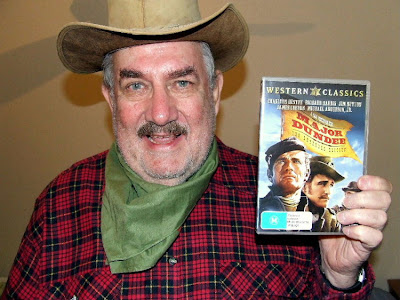
who directed him in the 1965 intense western “Major Dundee.”
As Heston recalled it in his autobiography (which I have
in my collection and found to be a enjoyable read) the actor
took umbrage after Peckinpah changed directions and swore
at the actor for disobeying his command. Heston drew his
saber and rode full-speed at the director, who leaped aside
only moments before the sword-wielding actor galloped past him.
“I can't believe I would have actually ridden Sam down, let
alone sabered him,” Heston wrote. “But I was as angry as
I can remember being in my life.” Heston would call
“Major Dundee” a “disappointing” film.
This film has since been re-released on DVD as a Director’s
Cut and I found this DVD release much more satisfying to
watch than the original version (that had been taken off
Peckinpah and re-cut and re-edited by the studio) and it
was this re-cut version which was shown at the cinema
and subsequently released on video cassette.
Heston, who was known as Chuck to his friends, was
popular within the movie community and, like Reagan,
was elected president of the Screen Actors Guild,
serving six terms from 1965 until 1971 and he also
chaired the American Film Institute.
Herston became a staunch opponent of gun control.
Elected president of the National Rifle Association in
1998, he held the job until 2003 and he proved to be
a powerful campaigner against what he saw as the
government’s attempt to infringe on a Constitutional
guarantee — the right to bear arms. In a speech at
the N.R.A.'s annual convention in 2000, he brought
the audience to its feet with a ringing attack on gun
control advocates. Paraphrasing an N.R.A. bumper
sticker ("I'll give you my gun when you take it from
my cold, dead hands") he waved a replica of a colonial
musket above his head and shouted defiantly,
"From my cold, dead hands!"

Heston frequently spoke out against what he saw as
evidence of the decline and debasement of American
culture. In 1992, appalled by the lyrics on “Cop Killer,”
a recording by the rap artist Ice T, he blasted the
album at a Time Warner stockholders meeting and
was a force in having it withdrawn from the marketplace.

Charlton Heston was cast as Michelangelo in the 1965
film version of Irving Stone's novel "The Agony and the Ecstasy."


Chuck with his wife Lydia and showing his medal after he was named Commandor in the Arts and Letters Order by French culture minister Philippe Douste-Blazy in Paris Monday March 17, 1997.

Charlton Heston during the signing of his book “In The Arena”
Although his days as the leading man were over, he
worked steadily in small but interesting roles, including
the one-eyed CIA director in James Cameron's
“True Lies,” the Player King in Kenneth Branagh's
“Hamlet,” a high-powered football commissioner in
Oliver Stone's “Any Given Sunday” and an uncredited
appearance in ape attire in Tim Burton's 2001 remake
of “Planet of the Apes.” (which in my opinion was bloody awful).

Chuck with Joey playing a guest role on the sitcom "Friends"


Charlton Heston is survived by
his wife, Lydia, their son Fraser and their adopted daughter Holly Rochell.
Charlton had appeared in over 100 movies and in
numerous TV shows. No matter what one may of
thought of some of the controversy he caused with
his views on gun control, it is the volume of work
that Chuck has left behind for all to view now and
for future generations to enjoy for years to come.
Only time will tell whether the film stars of today’s
movies will be as fondly remembered for as long
as yesterday’s legends have been appearing on the
big screen, then on TV, video cassette and now DVD.

 The next cruise was at